
Faith doesn't grow the same way in everyone, and that's by design
It can be scary when someone's faith starts to look different. But sometimes that's exactly what keeps their faith alive.

Have you ever seen a baby guinea pig? If not, don’t worry, I’ll save you a Google. It looks exactly like a grown-up guinea pig.
It’s smaller, of course. The baby guinea pig looks just like a grown-up guinea pig that has been scaled down. Like, if you didn’t have any context around it for its size, you wouldn’t be able to tell the difference between the grown-up and the baby. Tortoises are the same way. A tiny baby tortoise has the same markings on their shell, the same legs, the same face, the same everything as a much older grown-up tortoise.
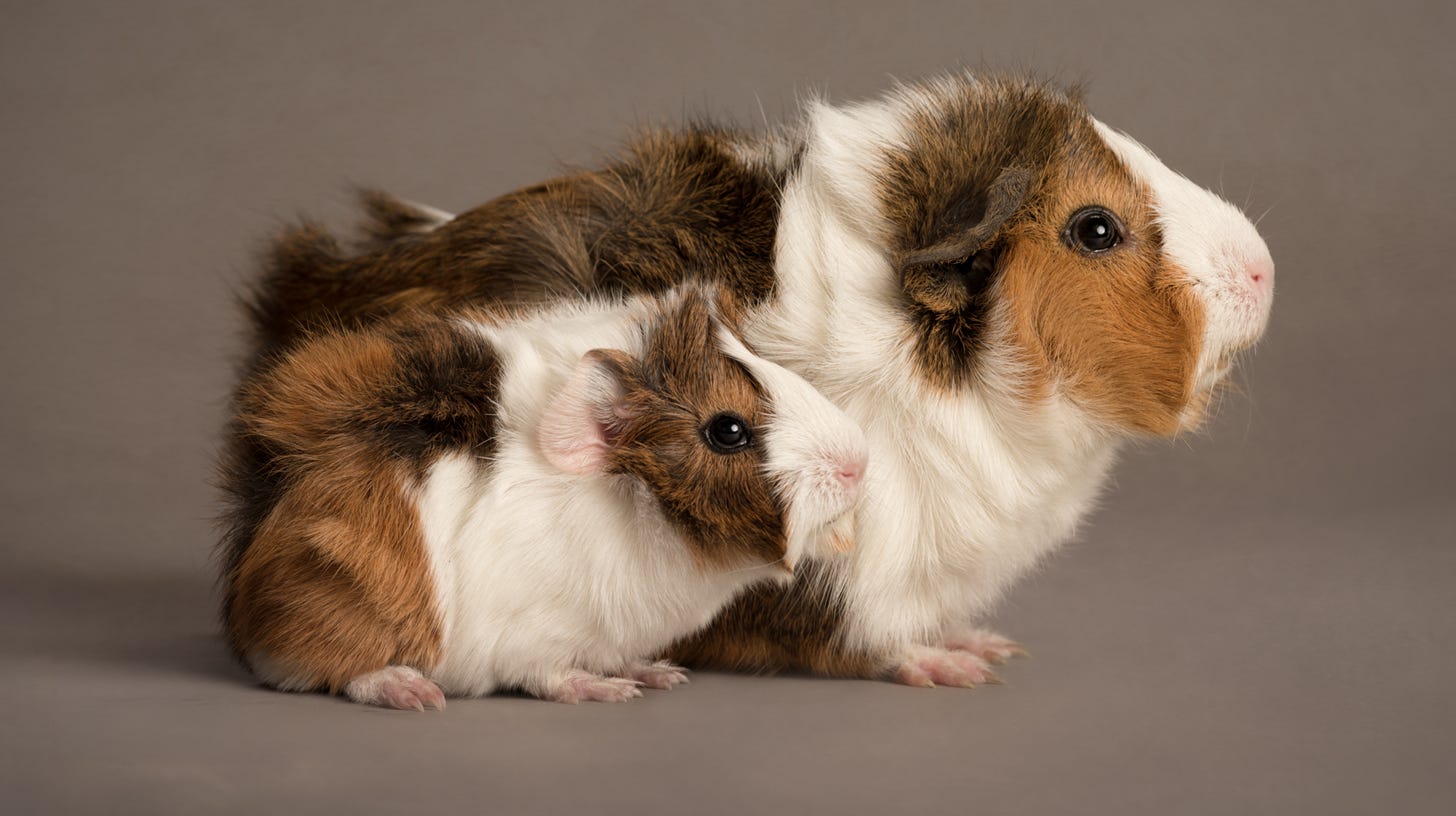
In biology, this kind of growth is called “direct development,” and it means exactly what I’ve been describing. Essentially, it means that babies are born as miniature adults and they grow up without any major changes in appearance other than size.
Other creatures, though, go through a full metamorphosis. This includes most insects (the classic example is a caterpillar turning into a butterfly, but it also includes beetles, ants, bees, and all sorts of others), amphibians like frogs and toads, and a few wildcards like jellyfish and eels. These creatures go through defined stages of development where they end up unrecognizable compared to their prior stages of growth. They change completely.
The process for a caterpillar turning into a butterfly is even wilder and weirder than it would seem; it’s not like the caterpillar goes into their chrysalis and simply grows wings.1 Instead, the caterpillar releases enzymes that essentially dissolve its entire body into a cellular goo. The only thing that remains intact are some groupings of cells call imaginal discs, which have been part of the caterpillar for its whole life but haven’t meant anything until now. These cell groups feed on the protein-rich goo that they’re floating in, inside the chrysalis, and turn into eyes, wings, and antennae. Finally, what’s left is a fully-formed butterfly—made entirely out of what used to be the caterpillar.2
Sometimes faith works that way, too.
In the Church, we’re used to the direct development path. As you get older, your faith looks the same it did when you were eight years old; you’re bearing the same testimony, just with more practice. Your grown-up faith is bigger than it used to be, and stronger, and it has the same features that it did when you were younger (this is what we describe as a “child-like” faith, in a good way). This is a great path for your faith to take.
I feel like I see a lot of people with “direct development” faith when I go to church. Either that’s more common among Latter-day Saints, or it’s how we like to be seen; my experience is that vulnerability around gospel questions is hard to come by at church. Instead, I hear talks about things people have already gained a testimony of, and lessons about challenges they have already overcome. These things are always past tense. And maybe it’s really because these people have their hardest testimony challenges behind them.
For other people, it looks different. Sometimes you get to the point where your old faith doesn’t sustain you anymore. Sometimes this is tied to something specific—concerns about Church history, say, or women’s issues—and sometimes it’s that you are doing all the things and not feeling the fulfillment that other people talk about.
It’s not that your faith has died, or even lessened. It’s that what you need spiritually has changed, and that’s not a failure. Sometimes this means putting in the spiritual effort to study out complex topics and find out how God really answers your prayers. This is also a great path for your faith to take.
Sister Michelle D. Craig described it this way:
Trust God to lead you, even if that way looks different than you expected or is different from others. Latter-day Saints come in many shapes and sizes, but “all are alike unto God”… No matter who you are or what you’re dealing with, you are invited to the Lord’s table.
Not only do Latter-day Saints come in all shapes and sizes, but our faith does too. Elder Jeffrey R. Holland compared it to the different voices in a choir:
…It is by divine design that not all the voices in God’s choir are the same. It takes variety—sopranos and altos, baritones and basses—to make rich music. …Our Heavenly Father delights to have us sing in our own voice, not someone else’s. Believe in yourself, and believe in Him. Don’t demean your worth or denigrate your contribution. Above all, don’t abandon your role in the chorus. Why? Because you are unique; you are irreplaceable.
When one caterpillar forms a chrysalis and starts to literally dissolve into goo, it must freak out the other caterpillars. “We’ve got to save him!” they say, in their caterpillar language. “Look what’s happening to him!” Many times we have the same reaction in the Church. When someone has sincere questions, the instinct kicks in to save them—maybe by suggesting that they pray more or read the scriptures more, or by testifying to/at them.3
This happens to me.
I write stuff online, as you know because you’re reading it, and I do so as someone whose faith looks different than it used to. It’s not the same faith I had when I was eight, scaled up to be bigger and stronger. Instead, there have been twists and turns, questions and doubts. I’ve re-explored my spiritual practices to find what works for me. I recognize my faith as something that is in motion, something that is living and changing. I don’t feel like a lot of Latter-day Saints talk about that. Out loud, anyway.
So I guess I shouldn’t be surprised when friends or family see the things I write and think I’ve turned to goop. I’ve gotten messages from old friends, people I know and respect, trying to coax me back onto whatever flavor of the straight and narrow path they’re on. They don’t know, I guess, that I’m an active, temple-recommend-carrying member of the Church. I’m the financial clerk in my ward. But all they can see is a chrysalis full of goo, and they want to save me from something I don’t need saving from.

I’m not saying you have to have doubts, or that having doubts is somehow spiritually superior to a more consistent faith. I’m saying it’s okay for your faith to go through a metamorphosis. It’s okay for your friend’s faith, or your child’s, or your spouse’s. It’s scary, for sure. It might not be same the path your faith takes. The paths are different, and neither is better—the same way that a butterfly isn’t better than a guinea pig, or the other way around. They look different, and they took different paths to get there, and in neither case is that a judgment of one being better than the other.
The thing about a butterfly is that it doesn’t replace the caterpillar; it is the caterpillar. It’s not made from other stuff or other sources, it’s made from everything that made the caterpillar a caterpillar. Similarly, as I’ve gone through some metamorphosis of my faith, it all comes back to some simple truths I learned in Primary. We’re all children of God. We’re all loved, without exception, by our Heavenly Parents. They’re always on our side, always cheering us on.
I’m not sure I’m a butterfly yet. I made just be goo at this point. Maybe you and I live or talk about the gospel a little bit differently from each other. But at the end of the day we’re all siblings in the family of God. No matter what our path looks like.
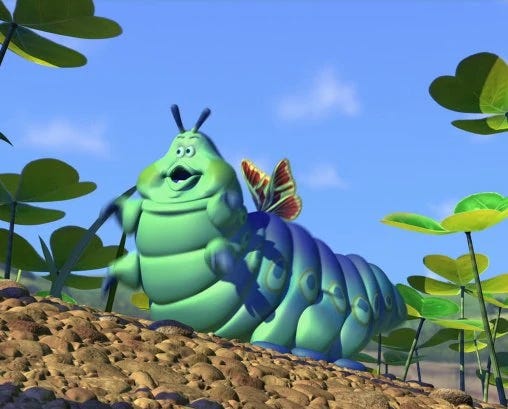
Even though that’s how it’s portrayed in Pixar’s “A Bug’s Life,” when Heimlich emerges and is still a caterpillar, just with wings. I am willing to give Pixar a pass on this, because the truth would probably be traumatizing for kids.
There are a variety of sources I could cite that walk through the details of the caterpillar-to-butterfly metamorphosis, but I’m going to link to this one because of how it describes the dissolved body as “caterpillar soup.”
You may find parallels between the idea of faith metamorphosis and concepts of faith stages, a la James Fowler and Brian McLaren. I’m not exploring that specifically here, but the underpinnings are similar.
Elder M. Russell Ballard, speaking to a group of CES teachers, said to stop doing exactly this:
Gone are the days when a student asked an honest question and a teacher responded, ‘Don’t worry about it!’ Gone are the days when a student raised a sincere concern and a teacher bore his or her testimony as a response intended to avoid the issue.
The caterpillar to butterfly transition concept is good because it feels scary. And also real. I read someone else pointing out that deconstructing your faith isn’t the endpoint. If you stop at deconstruction, you just end with goo, and that’s not viable. But deconstruction to reconstruction is how you end up with faith.
Excellent. Growth is not linear!